


GLOSSARY
-
Abbess - (from the Aramaic word: Amma, meaning "Mother") is the head of a Christian monastic order; in relation to St. Benedict's conception of an Abbess and monastic community, she was the matriarch of that spiritual family.
-
Anglicans - Christians shaped by the English Reformation as well as the theology and worship of the Church of England. Anglicans share a commonality of Christian faith expressed in documents like the 39 Articles, as well as on their historic relationship with the Church of England and adherence to Anglican practice – most poignantly symbolized by the style of worship reflected in The Book of Common Prayer.
-
ACNA - Anglican Church in North America. The Anglican Church in North America unites 112,000 Anglicans in nearly 1,000 congregations across the United States, Canada, and Mexico into a single Church. The Anglican Church in North America affirms the Church’s clear commitment to the uniqueness of Jesus Christ, the authority of Holy Scripture, and the historic faith of the Church declared in the three catholic creeds.
-
Ambrosian Hymn - a collection of early hymns of the Latin rite. They surround a core of genuine hymns composed by Saint Ambrose in the 4th century. The term "Ambrosian" does not imply authorship by Ambrose himself, to whom only four hymns are attributed with certainty, but includes all Latin hymns composed in the style of the Old Hymnal.
-
Antiphon - a short sentence sung or recited before or after a psalm, hymn, or chant.
-
Aspirant - a person who tries to become something; seeking to attain a desired position or status.
-
Bishops - given to us by Christ to act as our shepherds. Bishops, empowered to confer holy orders, are in charge of a diocese or jurisdiction of the faithful. The Bishop is the superior of all the priests in his dioceses, as well as the local spiritual leader.
-
Book of Common Prayer - the Anglican Prayer Book is known worldwide as one of the finest expressions of Christian prayer and worship. The 1662 Prayer Book is predominantly comprised of scriptures formulated into prayer. It has been the standard for Anglican doctrine, discipline and worship, and for subsequent revisions in many languages.
-
Brother - a man who is a member of a religious order. The term Brother generally indicates a man who does not live in a monastery (see Non-Cloistered), but may also be used by monks addressing each other, i.e. Brother Tom.
-
Canticle - a hymn, chant, or song that is part of a regular service.
-
Cellarer - the person in a monastery who is responsible for the provisioning of food.
-
Cenobite – one within a community who serves God under a religious rule and does so under the leadership of an abbot or abbess.
-
Charism - when religious life is seen as both a gift and a call.
-
Cincture - a rope-like cord with knotted ends, tied around the waist. Colors and styles may vary with position in a religious order.
-
Cloistered - separated from the rest of the world; being or living in a monastery or convent.
-
Compline - time of prayer at 9 pm or before retiring for night as part of the Liturgy of Hours; also called Night Prayer.
-
CONNAM - Church of Nigeria North American Mission. The Church of Nigeria North American Mission is an orthodox missionary jurisdiction of the Church of Nigeria [Anglican Communion].
-
Conversatio Morum - One of the three vows that all monks make. From the Latin for "conversation of life." It is a vow to a continual change of heart, a daily reshaping of the mind and heart according to God's plan for us. A conversion from fear to love.
-
Diocese - an ecclesial (church) jurisdiction comprised of parishes under the authority of a bishop.
-
Discalced - from Latin, meaning "without shoes;" a religious brother or sister who wears sandals or is barefoot.
-
Divine Hours - also known and Divine Office (see Liturgy of Hours).
-
Eucharist - the service of communion; Greek for “thanksgiving.” A Christian ceremony in which bread is eaten and wine is drunk as a way of showing devotion to Jesus Christ.
-
Evensong - another name for Evening Prayer.
-
Gyrovagues - censured by Benedict as worse than sarabaites, are wandering monks without stability in a particular monastery.
-
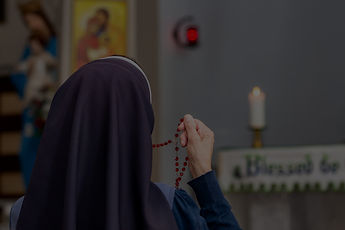
Habit - the clothing worn specifically by monastics. A habit may include a tunic, collar scapular, cincture, and a veil (if female). Usually, colors of habits are affiliated with a particular Rule of Life, example black is worn by Benedictines and brown by Franciscans.
-
Hermits – (also known as anchorites) one who withdrew from cities and moved to the desert or mountains, where they sought God through prayer in caves and shelters.
-
Juniorate - a period of reflection and study for candidates for the priesthood, brotherhood, or sisterhood.
-
Lauds - time of prayer at 3 am or at dawn as part of the Liturgy of Hours; also called Dawn Prayer.
-
Liturgical - of, relating to, or having the characteristics of the liturgy (a Eucharistic rite).
-
Liturgy of Hours - also known as the Divine Office; canonical hours utilizing a set of prayers "marking the hours of each day and sanctifying the day with prayer." Used as the basis of prayer within Christian monasticism, prayers in the Liturgy of Hours may consist of daily readings and psalms supplemented by hymns and antiphons.
-
Matins - time of prayer during the night, usually before dawn as part of the Liturgy of Hours; also called Vigils.
-
Monastic - religious brothers and sisters who live a rule of life centered on prayer, study, and service.
-
Monasticism - a movement of men and women moving away from the world to pursue holiness and become more like Christ.
-
Monk - a man who is a member of a religious order; usually lives in a monastery (see Cloistered).
-
Nicene Creed - the universal creed of the believing and worshiping community. The original Greek text used "We Believe," because this Creed reflects the belief of the whole Church as a united body, as contrasted with the Apostles' Creed which is a personal profession of faith used at baptism. The Nicene Creed was presented to the Council of Nicaea in the 4th Century to provide a clear statement of faith for the Church.
-
Non-Cloistered - one who lives and works in the world.
-
None - time of prayer at 3 pm as part of the Liturgy of Hours; also called Mid-Afternoon Prayer.
-
Novice - a person admitted to probationary membership in a religious community.
-
Nun - a woman who is a member of a religious order and lives in a convent (see Cloistered).
-
Nunc Dimittis - (also known as Song of Simeon or Canticle of Simeon) is a canticle from the opening words from the New Testament in the second chapter of Luke named after its incipit in Latin, meaning “Now you dismiss.”
-
Ora et Labora - "Prayer and Work"
-
Order - a community under a religious rule.
-
Parish - a defined, self-supporting community or congregation with a priest as its pastor. A diocese is comprised of a number of parishes.
-
Postulant - a person admitted to a religious order as a probationary candidate for membership.
-
Prayer Log - a record of daily prayers.
-
Priest - one who is ordained; has the authority to perform certain rites and administer certain sacraments, as well as minister and provide spiritual care for their parish and community. A priest can be secular (belonging to a diocese) and/or religious.
-
Prime - time of prayer at 6 am as part of the Liturgy of Hours; also called Early Morning Prayer.
-
Religious - way of life in which one renounces worldly pursuits and publicly professes to devote oneself fully to God and His work. In the context of Christian Orders, monastics publicly professed vows are regarded as the individual's free response to a call by God to follow Jesus Christ more closely under the action of the Holy Spirit in a particular form of religious living.
-
Sarabites - censured by Benedict as the most detestable kind of monks, are pretenders that have no cenobitic experience, follow no rule, and have no superior.
-
Scapular - originally aprons were worn by medieval monks; worn over a tunic at certain stages of monastic development; a somewhat large length of cloth suspended both front and back from the shoulders of the wearer, often reaching between the knees and the ankles.
-
Sext - time of prayer at 12 noon as part of the Liturgy of Hours; also called Midday Prayer.
-
Sister - a woman who is a member of a religious order. The term Sister generally indicates a woman who does not live in a convent (see Non-Cloistered), but may also be used by nuns addressing each other, i.e. Sister Mary.
-
Terce - time of prayer at 9 am as part of the Liturgy of Hours; also called Mid-Morning Prayer.
-
Third Order - an organization composed of lay people living in a secular society under a religious rule and directed by a religious order.
-
Tunic – also known as a “monk’s robe” clothes the monastic in modesty. Tunics are worn as part of a habit covering the wearer’s arms, torso, and legs and are colored according to the Order’s appropriate Rule of Life.
-
Veil - a fabric head-covering worn by monastic women as part of their habit. The veil may have different colors to indicate what type of vows the woman has made. Veiling may be required or optional according to each individual religious order.
-
Vespers - time of prayer at 6 pm as part of the Liturgy of Hours; also called Evening Prayer.
-
Vigils - (see Matins).
-
Vocation - a divine call to religious life.