PRAYER
Prayer of the Order Written by St. Dominic
May God the Father bless us.
May God the Son heal us.
May God the Holy Spirit enlighten us,
and give us
eyes to see with,
ears to hear with,
hands to do the work of God with,
feet to walk with,
a mouth to preach the word of salvation with,
and the angel of peace to watch over us and lead us at last,
by our Lord's gift, to the Kingdom. Amen.
Amma Sarah of the Desert said, "If I prayed God that all people should approve of my conduct, I should find myself a penitent at the door of each one, but I shall rather pray that my heart may be pure toward all."
Digging Deeper in Prayer
The Father, the Son, and the Holy Spirit are near to us at all times and will hear us whenever we pray. Through each step of discernment, we share various types of prayer for those in formation to learn about and integrate into their prayer life. Praying is a central and integral part of our Order. We not only pray the Daily Offices, but we also enjoy contemplative prayer and are often called to intercessory prayer.
It is not uncommon for others to ask the sisters to pray on their behalf with each sister eager to assist.
Praying the Daily Offices
Prayer (spontaneous and scheduled) is the foundation of the Sisters of Hope. It is expected that all members will heed the words of St. Paul who said, “Pray continually” (1 Thessalonians 5:17). However, there are certain prayers that we are to strive for on a daily basis as the minimum. The Sisters of Hope routinely practice praying at least two of the Divine or Daily Offices (or Liturgy of Hours). The following are descriptions of each:
-
Vigils or Matins - (during the night, usually at 2 am or just before sunrise) to adore the Holy Trinity; in thanksgiving for the resurrection of our Lord; and for all the gifts of God natural and supernatural, especially for Holy Baptism; and to pray for the spiritual resurrection of the souls of all the baptized.
-
Lauds or Prime - (at 6 am; also called Early Morning Prayer) to adore the Incarnation of the Divine Word, especially His being condemned by Pilate, reviled and scoffed at; to pray for those who we meet this day, those dear to us or those who we are bound to pray for; and to offer ourselves wholly to God.
-
Terce - (at 9 am; also called Mid-Morning Prayer) to adore the Holy Spirit in the Church and in the Christian soul; to pray for the needs of the Church and the unity of all Christians.
-
Sext - (at 12 noon; also called Midday Prayer) to adore our Lord in His public ministry; to pray for the spread of the Faith at home and abroad.
-
None - (at 3 pm; also called Mid-Afternoon Prayer) to adore our Savior in His Passion and Death; to pray for the afflicted; the sick and suffering, and those at the point of death.
-
Vespers or Evensong - (at 6 pm; also called Evening Prayer) to adore our Lord as He is taken from the Cross, placed in the arms of His mother and prepared for burial; in the thanksgiving for the Holy Eucharist; and to pray for a supply of holy, and learned priests and religious; and for all communicants.
-
Compline - (at 9 pm or before retiring for night; also called Night Prayer) to adore our Lord as He is laid in the sepulcher; to pray for the faithful departed, and for our own final perseverance.
Example resources for the Daily Offices, include:
-
The Book of Common Prayer 1928 or 2019 ACNA edition
The Rosary
"Like our ancestors in faith, we use beads to assist us in our prayer. Grasping and moving the beads helps us focus, integrating our senses of touch and sight into our experience of prayer. With fingers busy, our minds can be open to pondering the mysteries of God. In stressful times, simply holding the beads can be prayer, even when our minds are unable to focus on thoughts." ~ Dominican SIsters of Springfield, Illinois
Often the Christian prayer beads (rosaries) we know today are thought to have begun with St. Dominic using a total of
59 beads. What many may not know is that there is a set of prayer beads hundreds of years earlier associated with St.
Cuthbert. The number of “beads” St. Cuthbert used varied, but 33 segments were not uncommon. The Sisters of Hope
use what is known as the Anglican rosary which consists of 33 beads (one for each year of Jesus’ life). Some claim the
Anglican rosary was developed by Rev. Lynn Bauman in the mid-1980s, but the Sisters of Hope attribute the Anglican
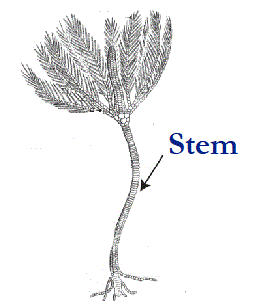
rosary to St. Cuthbert. St. Cuthbert's prayer beads were made from the ancient fossilized portions of the "stems" of
Carboniferous Crinoids. The lily (which is featured in our heraldry and is a Dominican symbol for purity) is also a part of
St. Cuthbert’s beads in the form of Crinoids also known as a "sea lily."
Below is a set of rosaries the Sisters of Hope recite on a daily basis utilizing Anglican prayer beads, also known as an Anglican rosary.